





Neðstikaupstaður
When the first monopoly traders arrived at Skutulsfjarðareyri, they built houses for themselves, likely one timber house and huts made of turf and stone. The oldest house still standing today is slightly younger: Krambúðin, built in 1757.
There was little reason to construct well-built dwellings for the merchants, as they rarely stayed over winter.
They usually arrived in spring and returned to Denmark in autumn. The authorities disapproved of overwintering merchants, fearing that their presence could lead the general public into drunkenness and wastefulness. Staying the winter was also not always safe for the merchants themselves. At least one, Adrian Jensen Munch, who chose to do so, was murdered in a conflict with four locals. He reportedly refused to sell them tobacco.
In 1764, the Almenna verslunarfélagið (General Trading Company) took over trade in Iceland and winter merchants in all the Westfjords ports and at Eyrarbakki decided to stay throughout winter. The main reason for this was likely the company’s efforts to teach Icelanders how to process salted cod, which had become a sought-after commodity across Europe. The Westfjords were ideal for this due to their rich fishing grounds and suitable climate. Naturally, it was necessary to build a residence for the trading manager (the faktor) if he were to stay year-round. In 1765, a residential house was built – which is still inhabited – known as Faktorshúsið (The Factor’s House). Around the year 1900, about a dozen buildings stood in Neðstikaupstaður. In addition to Krambúðin and Faktorshúsið, two others still stand: Tjöruhúsið, built in 1781, and Turnhúsið, built in 1784 – both originally constructed as warehouses.
When the trade monopoly was lifted in 1787, a group of Danish merchants from Altona took over operations. They only lasted six years, until 1793. Later merchants fared better, and a characteristic of Neðstikaupstaður was that its merchants tended to stay for long periods. After the Altona group left, partners Jens Lassen Busch and Henrik Christian Paus took over the business. Their trade continued for 30 years until 1824, when wholesale merchant Matthías Wilhelm Sass purchased it. Sass and his descendants operated the trade in Neðstikaupstaður for 59 years until 1883. That trading company gained fame for building the first seafaring ship pier in Iceland in 1868.
In 1883, Sass's business was sold to Ásgeir G. Ásgeirsson, and over the following years Neðstikaupstaður became the centre of the largest privately-owned trading company in Iceland. Ásgeirsverslun operated until 1918, when it was taken over by Hinar sameinuðu íslensku verslanir (The United Icelandic Trading Companies). However, the lifespan of this new operation was short: in 1926, the company went bankrupt, bringing an end to commercial activity in Neðstikaupstaður.
Around 1950, Jóhann Gunnar Ólafsson, the district commissioner, spearheaded the revival of the Westfjords Heritage Museum (Byggðasafn Vestfjarða). Acting on behalf of the museum, he launched a passionate campaign to preserve the historic 18th-century houses in Ísafjörður. He contributed annual articles to the Ísafjörður Historical Society’s yearbooks, drawing attention to the cultural value of these buildings. Jóhann Gunnar referenced painter Hörður Ágústsson, who had written extensively about the houses in the cultural magazine Birting (1962, issues 1 and 2). At the time, the town council planned to demolish the residential house in Hæstikaupstaður. Thanks to Jóhann Gunnar’s advocacy, the demolition was postponed, and the council requested a detailed report on the fate of the old buildings.
As a result, the demolition was halted—not only for the Hæstikaupstaður house but also for the buildings in Neðstikaupstaður and the Salt House in Þingeyri, all dating from the same period. Today, these structures are recognised as true crown jewels of Ísafjörður’s architectural heritage. In 1975, following the town council’s request, they were granted protected status. The dedication of those who fought for their preservation is still deeply appreciated.
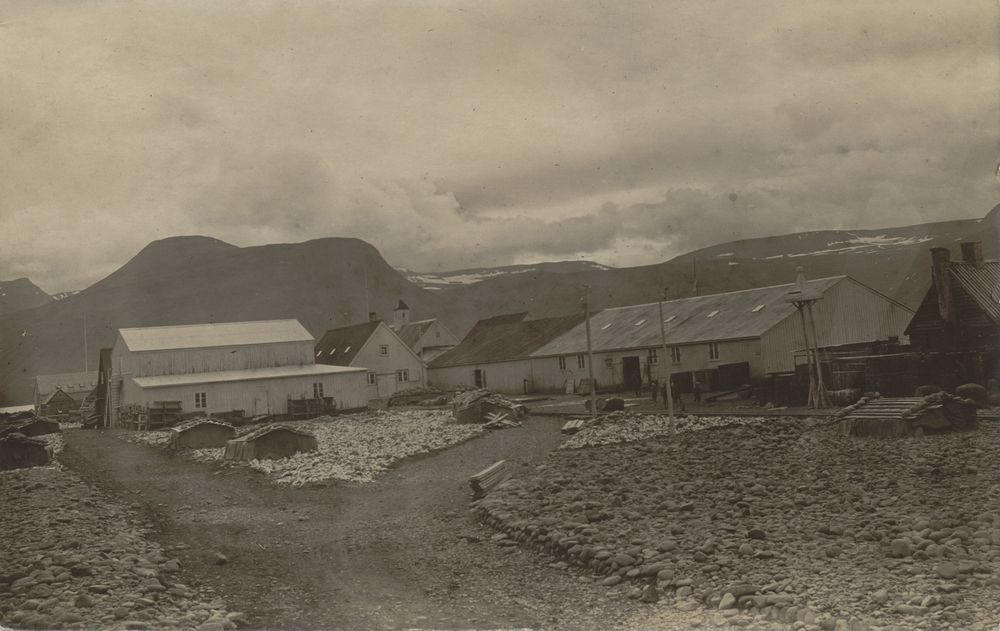
Lower town around 1920